
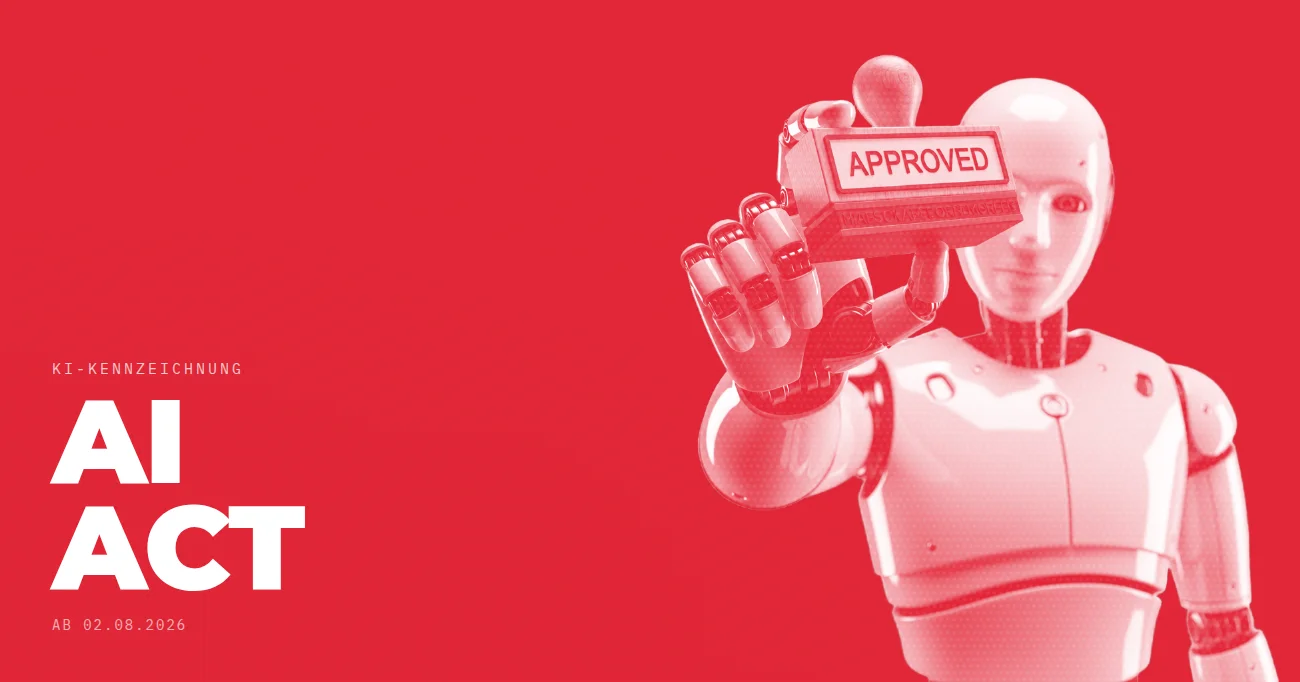
When does AI in marketing need to be labelled?
Not because AI is being banned. But because people should be able to recognise when content has been artificially generated or significantly altered. An interactive guide for marketing teams.
Note: Not legal advice — a practical guide for marketing, social media, and brand teams.
It’s about transparency, not an AI ban
Article 50 of the AI Act regulates transparency obligations for certain AI systems and AI content. For marketing, the most relevant aspect is: If AI creates or manipulates content that can appear to be real persons, places, objects, events, or statements, a disclosure obligation may arise.
The classic example is the deepfake. But deepfake doesn't just mean a face swap with a politician. A realistically appearing AI influencer, an event that never took place, an artificially enhanced product situation, or a synthetic voice can also become relevant.
“Was AI involved?” is the wrong question — AI is now in almost every production step. What matters is the effect on the audience:
“Can our audience believe that this is real?”
If so, labelling becomes relevant.
If it can seem real, AI must be made visible
For images, videos, and audio, it is about the impression of authenticity. A small crop or a technical colour correction are usually something different than a newly generated realistic condition — such as a virtually furnished apartment, a retouched car, or a rainy day in Vienna becoming bright sunshine.
Move the slider through the spectrum — and see where fine-tuning becomes a new reality:
A product photo is minimally cropped.
For video, it becomes even more sensitive: face swaps, AI avatars, synthetic lip-syncing, or events that never took place quickly create a false impression of authenticity. For audio, the same applies to voice clones, invented interviews, or synthetic statements.
The self-test: Does this asset need a label?
This is exactly where it becomes difficult in daily practice. Not with the abstract question of whether the AI Act is important — but with this one Reel, this one product view, this one creator asset. Play it through:
Image, video, audio or text — regardless of the format.
Rough initial assessment — does not replace legal advice
By the way, the same deepfake test does not apply to texts: normal captions and advertising copy are not automatically subject to labelling just because AI helped with the writing. It becomes more critical with texts on topics of public interest — politics, health, safety, the environment — without substantial human review. A spell check is not enough for that. A proper review is more likely to suffice.
Chatbots must identify themselves early on
When a chatbot, voicebot, or autonomous AI community manager communicates with humans, the AI character must be clear in principle before the first substantive response .
Not affected: A human uses AI as a drafting aid and decides, checks, and sends the message themselves. Affected: Systems that respond themselves — automatic DMs, service bots, AI community management.
The label must work from first contact
The most important operational point: A label helps little if it only becomes visible after someone clicks on “See more”. Compare for yourselves:
The first contact in the feed is what counts. A label that only becomes visible after clicking on “see more” is of little help — the deception has long since occurred in the image before anyone opens the caption. Left in the phone mockup: The label is invisible.
For the DACH region, a specific, clear label is often more practical than the pure EU icon: “AI-generated” and “AI-edited”. What is important is not the prettiest icon, but clarity — clear, distinguishable, perceptible, and accessible. Alt-texts, subtitles, and transcripts supplement the visible label but do not replace it.
An AI label does not make misleading advertising legal
Perhaps the most important point for marketing teams: The AI Act and fair trading law — in Austria, primarily the UWG (Unfair Competition Act) against misleading business practices — are two separate assessments. If a statement is false, it does not become okay just because “AI-generated” is written next to it.
What brands should prepare now
In many companies, the AI Act will not fail due to a grand strategy, but due to small production details. What makes sense is not an 80-page PDF that nobody uses — but a short operational standard. Check off what you can already answer: